NSL – Netzwerk Stadt und Landschaft ETH Zürich
  • Projects
      • Projects of the Chairs
        • Prof. Dr. Bryan T. Adey | Infrastructure Management
        • Prof. Dr. Tom Avermaete | History and Theory of Urban Design
        • Prof. Dr. Francesco Corman | Transport Systems
        • Prof. Teresa Galí-Izard | Chair of Being Alive
        • Prof. Dr. Adrienne Grêt-Regamey | Planning of Landscape and Urban Systems (PLUS)
        • Prof. Dr. Eva Heinen | Transportation and Mobility Planning
        • Prof. Dr. David Kaufmann | Spatial Development and Urban Policy
        • Prof. Hubert Klumpner | Architecture and Urban Design
        • Dr. Anastasios Kouvelas | Traffic Engineering and Control
        • Prof. Freek Persyn | NEWROPE Chair of Architecture and Urban Transformation
        • Prof. Milica Topalovic | Architecture and Territorial Planning
        • Dr. Jennifer Duyne Barenstein | ETH Wohnforum – ETH CASE
        • NSL-Archiv
      • Former Chairs
      • NSL Colloquia – The NSL Colloquia are a bi-annual presentation of exceptional work under a rotating theme determined by the inviting professor.
      • NSL Projects
          • E-Bike City
          • Future Cities Lab Global
          • Urban Potential and Strategies in Metropolitan Territories
 – The Zurich Metropolitan Region as an Example (NFP65)
          • Large-scale Virtualization and Modeling Lab (LVML)
      • NSL Forum
        • NSL Forum & Cycling Research Board
        • NSL Forum: Pandemie? Mitten im Klimawandel. Was bedeutet das für die räumliche Entwicklung der Schweiz? Ein Dialog.
    Close
  • Teaching
    • Teaching
      • Bachelor and Master Degree Programmes, Department ARCH
      • Bachelor and Master Degree Programmes, Department BAUG
      • MSc in Spatial Development and Infrastructure Systems
      • MAS/CAS in Regenerative Materials
      • CAS ETH in Regenerative Systems: Sustainability to Regeneration
      • MAS/CAS Spatial Development
      • MAS Urban and Territorial Design
      • MAS in Housing
      • Doctoral Programme in Landscape and Urban Studies
      • The teaching component of the NSL seeks to impart the knowledge and skills needed to develop the standard strengths of spatial planning and their interaction as well as the ability to develop strategies for the solution of spatial problems. These are central prerequisites for a responsible and successful exercise of planning functions in the service of the public commonwealth and of private companies. Especially important in fufilling these prerequisites is the quality of university-level education: graduate and post-graduate work as well as professional development in spatial, urban and landscape planning. The ETH Zurich has offered programmes such as continuing education courses and post-graduate programmes (NDS, now MAS) since 1965. The NSL (Network City and Landscape) is responsible for these courses and programmes.
    Close
  • Publications
    • NSL Newsletter – The NSL brings the experts at ETH Zurich together and also maintains a dialogue with other groups that deal with or are interested in issues relating to cities and landscapes.
    • Example Book Pages from "Working on Transformation"Publications of NSL Chairs – A complete list of publications can be reached via the following link, which also includes advanced search capabilities:
      • ETH Zürich Research Collection
    • disP Cover, Ausgabe 61/2, September 2025disP – The Planning Review – The interdisciplinary scientific journal covers the topics of spatial development, urban planning, landscape and environmental planning, landscape architecture, traffic planning, and regional and environmental economics, as well as special issues on specific themes.
      • Instructions for Authors
      • Types of Articles
      • Book Review Guidelines
      • Editorial Team
      • Latest Issue
      • facebook
    • DELUS Cover Issue 1DELUS – Journal for Landscape and Urban Studies – DELUS is an annual publication by the Institute of Landscape and Urban Studies at ETH Zürich.
    Close
  • News
  • Contact
      • en
        • de
        • fr
        • it
      • Search

    • Close
      • en
        • de
        • fr
        • it

Identifying levers of urban neighbourhood transformation using serious games

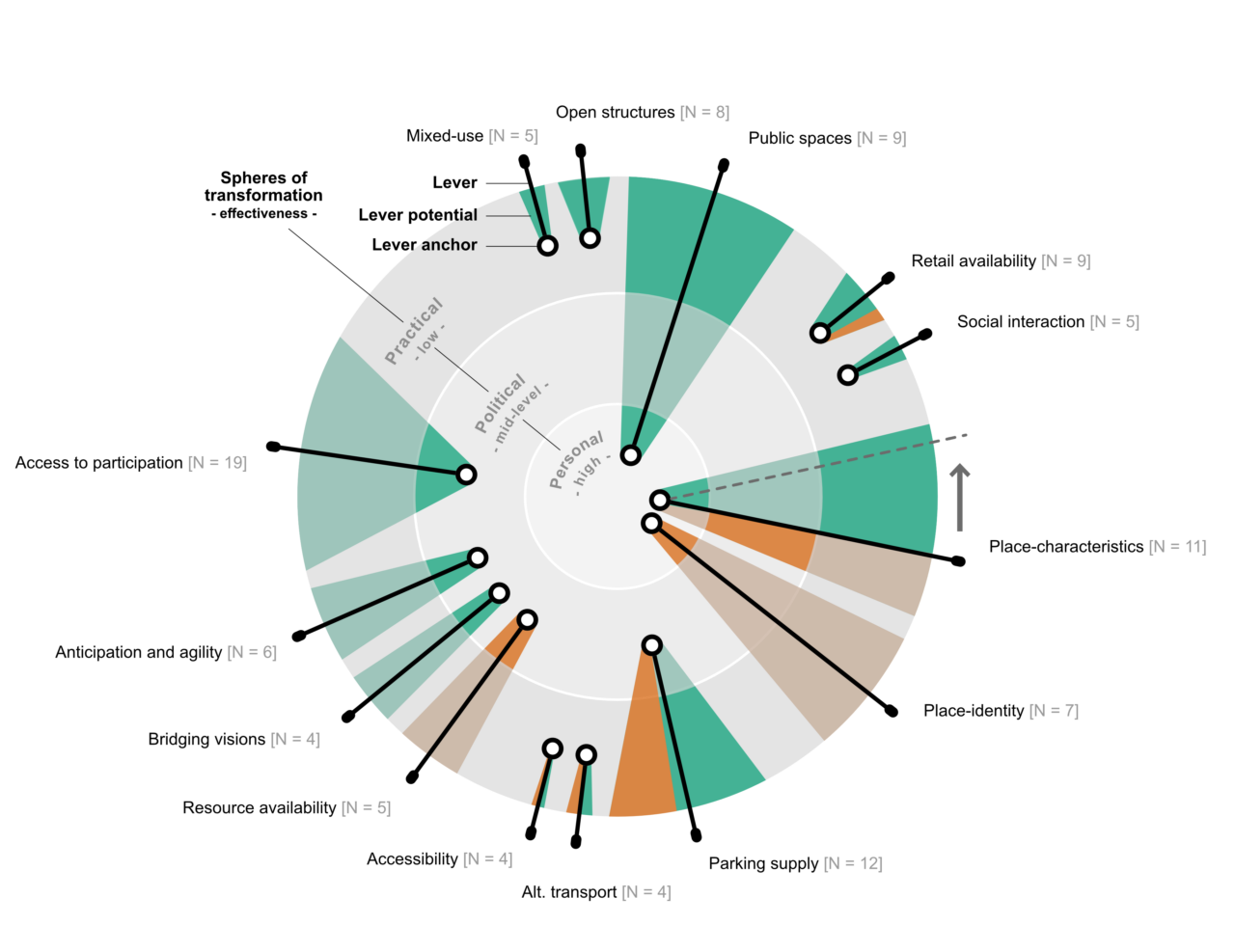
The span of each lever shows their identified- (bright colors) and possible- (faded colors) interactions with the Three Spheres of Transformation based on a minimum of two statements (Supplementary Table 7). The “lever potential” shows the enabling- (green) or hindering (red) potential scaled by the number of statements addressing this potential (Supplementary Figure 1). Engaging a lever symbolizes unlocking transformative change, e.g. for place-characteristics through engaging enabling interactions with the practical- and personal sphere, whilst avoiding hindering interactions with the political sphere. © ETH Zürich

Johann S. Schuur, Michal Switalski, Nicolas Salliou, Adrienne Grêt-Regamey
2024
Full text

Growing urban population and contemporary urban systems lock-in unsustainable urban development pathways, deteriorating the living quality of urban dwellers. The systemic complexity of these challenges renders it difficult to find solutions using existing planning processes.

Alternatively, transformative planning processes are radical, take place on multiple scales, and are often irreversible; therefore, require the integration of local stakeholders’ perspectives, which are often contradictory. We identify perceived levers of urban transformative change using a serious game to facilitate the integration of these perspectives through simulating neighbourhood transformation processes in two European case studies. Building on existing transformation frameworks, we organize, conceptualize, and compare the effectiveness of these levers through demonstrating their interactions with different scales of transformation. Specifically, drawing from close commonalities between large-scale (Three Spheres of Transformation) and place-based (Place-making) transformation frameworks, we show how these interactions can help to develop recommendations to unlock urban transformative change. Results show that access to participation is a key lever enabling urban transformative change. It appears to be mid-level effective to unlock urban transformative change through interactions with the political sphere of transformation and procedural element of Place-making. Ultimately, however, most effective are those levers that interact with all scales of transformation. For example, by engaging a combination of levers including access to participation, public spaces, parking, place-characteristics and place-identity. These findings could be operationalized by self-organized transformation processes focused on repurposing hard infrastructure into public spaces, whilst ensuring continuity of place-based social- and physical features. Local stakeholders could further use such processes to better understand and engage with their individual roles in the transformative process, because interactions with the personal scale, i.e., personal sphere of transformation appear paramount to unlock urban transformative change.

Published in: npj Urban Sustainability volume 4, Article number: 5 (2024)

×
Share this...
  • Facebook
  • Linkedin
  • Whatsapp
  • Email
This article has been published in the following newsletter edition:

61 | März 2024: Mobilität und Transport-Infrastruktur / Mobility and Transport Infrastructure

  • Envisioning a Cycling-centric Future: Urban Traffic Modeling and Management for a Bi-modal Network
  • How Will the Railway Look Like in 2050?
  • Stress Testing Transport Systems
  • Globale Modellierung des ländlichen Strassenverkehrs ausserhalb der Städte
Kurzmeldungen
  • Damian Jerjen named «Professor of Practice»
  • Maintenance and Advanced Analytics in Railways
Publikationen
  • disP 59/3, September 2023
  • Identifying levers of urban neighbourhood transformation using serious games
  • Public Support for Participation in Local Development
  • Time-to-Green Predictions for Fully-Actuated Signal Control Systems With Supervised Learning
  • Explainable Train Delay Propagation: A Graph Attention Network Approach
  • disP 59/4, December 2023
Weiterbildung / Studiengänge
  • CAS ETH in Zukunft der Raumentwicklung
  • MAS ETH in Regenerative Systems
  • EPFL ETH MAS Urban and Territorial Design
  • MAS ETH in Housing
  • Master of Science in Landscape Architecture
Aktuell
  • 2 + 2 + 1 A Collective Discussion on the Role of Landscape Architecture
  • 10-Minuten-Nachbarschaften
  • Neue Ansätze in der Modellierung: «The German experiment with low flat rates for public transport. An economic and political evaluation»
  • Abschlussvorlesung / Final Lecture Prof. Dr. Christian Schmid: No Condition is Permanent
  • ETH STUDIO BASEL Open Access: Public Launch
  • MEHR WOHNRAUM IN STÄDTEN – Wie gelingt die innere Verdichtung?
  • 10-Minuten-Nachbarschaften – Eine Tour rund um den Idaplatz
  • NSL Forum & Cycling Research Board
  • Beyond Maintenance: Responsive Practices for Changing Landscapes

Chairs

Prof. Dr. Bryan T. Adey
Prof. Dr. Tom Avermaete
Prof. Maria Conen
Prof. Dr. Francesco Corman
Dr. Jennifer Duyne Barenstein
Prof. Teresa Galí-Izard
Prof. Dr. Adrienne Grêt-Regamey
Prof. Dr. Guillaume Habert
Prof. Dr. Eva Heinen
Prof. Damian Jerjen
Prof. Dr. David Kaufmann
Prof. Hubert Klumpner
Dr. Anastasios Kouvelas
Prof. Freek Persyn
Prof. Milica Topalovic
Prof. Martina Voser

Contact

Address
ETH Zürich
NSL – Netzwerk Stadt und Landschaft
Stefano-Franscini-Platz 5
HIL H 44.2
8093 Zürich

NSL Director
Director: Prof. Dr. Milica Topalović
Deputy Director: Prof. Dr. Eva Heinen

NSL Coordination
Claudia Gebert
Telephone: +41 (0)44 633 36 33


Register for the NSL Newsletter

disP Publication Office

Editor-in-Chief
Prof. Dr. David Kaufmann

Managing Editor
Dr. sc. techn. Martina Koll-Schretzenmayr, Spatial planner ETH/NDS,
Telephone +41 (0)44 633 29 47

Mailing address
ETH Zürich
Redaktion disP
NSL – Netzwerk Stadt und Landschaft
Stefano-Franscini-Platz 5
HIL H 33.3
8093 Zürich
Email disP editorial team


NSL Archive (gta)

Research and Bequest Archive for
Swiss Landscape Architecture and Spatial Planning

Contact

Consultation Requests


Privacy Policy