NSL – Netzwerk Stadt und Landschaft ETH Zürich
  • Projects
      • Projects of the Chairs
        • Prof. Dr. Bryan T. Adey | Infrastructure Management
        • Prof. Dr. Tom Avermaete | History and Theory of Urban Design
        • Prof. Dr. Francesco Corman | Transport Systems
        • Prof. Teresa Galí-Izard | Chair of Being Alive
        • Prof. Dr. Adrienne Grêt-Regamey | Planning of Landscape and Urban Systems (PLUS)
        • Prof. Dr. Eva Heinen | Transportation and Mobility Planning
        • Prof. Dr. David Kaufmann | Spatial Development and Urban Policy
        • Prof. Hubert Klumpner | Architecture and Urban Design
        • Dr. Anastasios Kouvelas | Traffic Engineering and Control
        • Prof. Freek Persyn | NEWROPE Chair of Architecture and Urban Transformation
        • Prof. Milica Topalovic | Architecture and Territorial Planning
        • Dr. Jennifer Duyne Barenstein | ETH Wohnforum – ETH CASE
        • NSL-Archiv
      • Former Chairs
      • NSL Colloquia – The NSL Colloquia are a bi-annual presentation of exceptional work under a rotating theme determined by the inviting professor.
      • NSL Projects
          • E-Bike City
          • Future Cities Lab Global
          • Urban Potential and Strategies in Metropolitan Territories
 – The Zurich Metropolitan Region as an Example (NFP65)
          • Large-scale Virtualization and Modeling Lab (LVML)
      • NSL Forum
        • NSL Forum & Cycling Research Board
        • NSL Forum: Pandemie? Mitten im Klimawandel. Was bedeutet das für die räumliche Entwicklung der Schweiz? Ein Dialog.
    Close
  • Teaching
    • Teaching
      • Bachelor and Master Degree Programmes, Department ARCH
      • Bachelor and Master Degree Programmes, Department BAUG
      • MSc in Spatial Development and Infrastructure Systems
      • MAS/CAS in Regenerative Materials
      • CAS ETH in Regenerative Systems: Sustainability to Regeneration
      • MAS/CAS Spatial Development
      • MAS Urban and Territorial Design
      • MAS in Housing
      • Doctoral Programme in Landscape and Urban Studies
      • The teaching component of the NSL seeks to impart the knowledge and skills needed to develop the standard strengths of spatial planning and their interaction as well as the ability to develop strategies for the solution of spatial problems. These are central prerequisites for a responsible and successful exercise of planning functions in the service of the public commonwealth and of private companies. Especially important in fufilling these prerequisites is the quality of university-level education: graduate and post-graduate work as well as professional development in spatial, urban and landscape planning. The ETH Zurich has offered programmes such as continuing education courses and post-graduate programmes (NDS, now MAS) since 1965. The NSL (Network City and Landscape) is responsible for these courses and programmes.
    Close
  • Publications
    • NSL Newsletter – The NSL brings the experts at ETH Zurich together and also maintains a dialogue with other groups that deal with or are interested in issues relating to cities and landscapes.
    • Example Book Pages from "Working on Transformation"Publications of NSL Chairs – A complete list of publications can be reached via the following link, which also includes advanced search capabilities:
      • ETH Zürich Research Collection
    • disP Cover, Ausgabe 61/2, September 2025disP – The Planning Review – The interdisciplinary scientific journal covers the topics of spatial development, urban planning, landscape and environmental planning, landscape architecture, traffic planning, and regional and environmental economics, as well as special issues on specific themes.
      • Instructions for Authors
      • Types of Articles
      • Book Review Guidelines
      • Editorial Team
      • Latest Issue
      • facebook
    • DELUS Cover Issue 1DELUS – Journal for Landscape and Urban Studies – DELUS is an annual publication by the Institute of Landscape and Urban Studies at ETH Zürich.
    Close
  • News
  • Contact
      • en
        • de
        • fr
        • it
      • Search

    • Close
      • en
        • de
        • fr
        • it

Kollaborative Plattformen für mehr Resilienz in der Planung urbaner Landschaften

Städte und Agglomerationen sollen qualitativ hochwertigen Lebensraum für ihre Bewohnerinnen und Bewohner bieten. Dieses Ziel zu erreichen, ist nicht leicht. Adäquate Planungsansätze müssen das komplexe sozio-ökologische System von urbanen Landschaften mit einbeziehen, denn urbane Gebiete haben einen wesentlichen Einfluss auf das Funktionieren der Biosphäre auf allen Massstabsebenen. Die Belastbarkeit und Widerstandsfähigkeit des Systems, also seine Resilienz, sind wichtige Kriterien für eine zielführende Planung. Kollaborative Lernprozesse, die mit wissenschaftlichen Methoden unterstützt werden, können praktikable Ansätze für mehr Resilienz in der Planung sein.

Baulücken nutzen, Industrieareale umnutzen oder die Ausnützung erhöhen verändern Siedlungsmuster. Dies hat auf unterschiedlichen Massstabsebenen vielfache und miteinander verknüpfte Auswirkungen auf sozio-ökonomische und ökologische Aspekte. Wissenschaftliche Methoden zur Analyse dieser Auswirkungen werden in der Planungspraxis jedoch kaum eingesetzt. Unerwünschte Effekte, wie potentiell steigende Wohnungspreise und Gentrifizierung oder ungenügende Flächen für Erholung und Artenvielfalt, können in der Planung unentdeckt bleiben. Wichtig sind deshalb disziplinen- und massstabsübergreifende Kollaborationsprozesse von Wissenschaft und Praxis, in denen ein umfassendes Verständnis von Wechselwirkungen der raumwirksamen Faktoren erlangt wird.

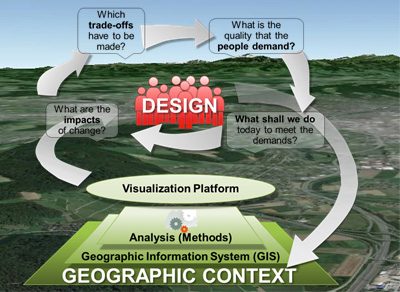
Doch wie können kollaborative Lernprozesse organisiert werden, die zu Ansätzen für die Transformation urbaner Landschaften führen, die sowohl wissenschaftliche Methoden als auch gesellschaftliche Werte einbinden? Wie können Akteurinnen und Akteure die Auswirkungen in integrierter Form reflektieren und entsprechend ihr Handeln ändern, das in der Summe zu lebenswerten und resilienten urbanen Landschaften führt? Basierend auf den Ergebnissen des NFP 65 Projekts «SUPat – Sustainable Urban Patterns» (www.supat.ethz.ch) wurde dieser Frage nachgegangen und ein prozedurales Konzept entwickelt.

In dem Projekt wurden unterschiedliche wissenschaftliche Methoden und Instrumente erarbeitet. Mit einem Fragebogen werden die Bedürfnisse der Bevölkerung vor Ort und Faktoren für ihre Ortsverbundenheit erfasst. Ein prozedurales 3D Modell der Bau- und Zonenordnung unterstützt die Entwicklung von Gestaltungsoptionen oder eine BZO-Revision. Die Auswirkungen solcher Revisionen werden mit einem agentenbasierten Modell simuliert und Indikatoren z.B. für die Erreichbarkeit, die Freiraumversorgung oder die räumliche Verteilung der Wohnungspreise berechnet. Da nicht alle Qualitäten überall maximiert werden können, werden mit einer multikriteriellen Entscheidungsanalyse politische Ziele gewichtet und Auswirkungen auf andere Qualitäten simuliert. So können Ansprüche von Akteuren reflektiert und Gestaltungsoptionen in einem iterativen Lernprozess angepasst werden.

Der Einsatz dieses kollaborativen Lernprozesses in der Praxis ist notwendig, damit man sieht, zu welchen Einsichten er führt. Deshalb sollten kollaborative Plattformen für eine kontinuierliche regionale Zusammenarbeit eingerichtet und mit einem Monitoring der sozialen Effekte und des Prozesses über die Zeit begleitet werden. Diese bieten die Chance, dass durch den Lernprozess sowohl eine vertikale (massstabsübergreifende) als auch eine horizontale (disziplinenübergreifende) Harmonisierung von räumlichem Handeln und damit einer Transformation hin zu resilienteren Siedlungsmustern gefördert wird.

Dr. Ulrike Wissen Hayek ist Oberassistentin an der Professur von Adrienne Grêt-Regamey, Planung von Landschaft und Urbanen Systemen (PLUS), am Institut für Raum- und Landschaftsentwicklung der ETH Zürich. Sie leitete und koordinierte die transdisziplinäre Zusammenarbeit im Rahmen des NFP65-Projekts «SUPat – Sustainable Urban Patterns».

Keynote: Digital Methods and Collaborative Platforms for Informing Design Values with Science. 23.05.2014, Grêt-Regamey, Adrienne

Wissen Hayek, Ulrike; Neuenschwander, Noemi; von Wirth, Timo; Kunze, Antje; Halatsch, Jan; Schmitt, Gerhard; Grêt-Regamey, Adrienne (2014): Combining Three Modelling and Visualization Tools for Collaborative Planning of Urban Transformation. In: Wissen Hayek, Ulrike; Fricker, Pia; Buhmann, Erich (Eds.): Peer Reviewed Proceedings of Digital Landscape Architecture 2014 at ETH Zurich. Berlin/Offenbach: Herbert Wichmann Verlag, VDE VERLAG GMBH. PDF

Share this...
  • Facebook
  • Linkedin
  • Whatsapp
  • Email
This article has been published in the following newsletter edition:

23 | September 2014: Resilienz

  • Kollaborative Plattformen für mehr Resilienz in der Planung urbaner Landschaften
  • Verbindung von Energie- und Ortsplanung: Zernez Energia 2020
  • Tight timetable vs. resilient network
  • New Visions for the Linth Valley
  • Resilienz von sensiblen Ökosystemen am Beispiel Trockenwiesen
  • Das Forschungsprogramm «Future Resilient Systems» des ETH-Singapore Centres startet
Kurzmeldungen
  • Generalized effects of on-street parking manoeuvres on the performance of nearby signalized intersections
  • Tagung Digital Landscape Achitecture DLA 2014
  • Empower Shack: South African informal settlements
Publikationen
  • Using connected vehicle technology to improve efficiency of intersections
  • A multiscale classification of the urban morphology

Chairs

Prof. Dr. Bryan T. Adey
Prof. Dr. Tom Avermaete
Prof. Maria Conen
Prof. Dr. Francesco Corman
Dr. Jennifer Duyne Barenstein
Prof. Teresa Galí-Izard
Prof. Dr. Adrienne Grêt-Regamey
Prof. Dr. Guillaume Habert
Prof. Dr. Eva Heinen
Prof. Damian Jerjen
Prof. Dr. David Kaufmann
Prof. Hubert Klumpner
Dr. Anastasios Kouvelas
Prof. Freek Persyn
Prof. Milica Topalovic
Prof. Martina Voser

Contact

Address
ETH Zürich
NSL – Netzwerk Stadt und Landschaft
Stefano-Franscini-Platz 5
HIL H 44.2
8093 Zürich

NSL Director
Director: Prof. Dr. Milica Topalović
Deputy Director: Prof. Dr. Eva Heinen

NSL Coordination
Claudia Gebert
Telephone: +41 (0)44 633 36 33


Register for the NSL Newsletter

disP Publication Office

Editor-in-Chief
Prof. Dr. David Kaufmann

Managing Editor
Dr. sc. techn. Martina Koll-Schretzenmayr, Spatial planner ETH/NDS,
Telephone +41 (0)44 633 29 47

Mailing address
ETH Zürich
Redaktion disP
NSL – Netzwerk Stadt und Landschaft
Stefano-Franscini-Platz 5
HIL H 33.3
8093 Zürich
Email disP editorial team


NSL Archive (gta)

Research and Bequest Archive for
Swiss Landscape Architecture and Spatial Planning

Contact

Consultation Requests


Privacy Policy