NSL – Netzwerk Stadt und Landschaft ETH Zürich
  • Projects
      • Projects of the Chairs
        • Prof. Dr. Bryan T. Adey | Infrastructure Management
        • Prof. Dr. Tom Avermaete | History and Theory of Urban Design
        • Prof. Dr. Francesco Corman | Transport Systems
        • Prof. Teresa Galí-Izard | Chair of Being Alive
        • Prof. Dr. Adrienne Grêt-Regamey | Planning of Landscape and Urban Systems (PLUS)
        • Prof. Dr. Eva Heinen | Transportation and Mobility Planning
        • Prof. Dr. David Kaufmann | Spatial Development and Urban Policy
        • Prof. Hubert Klumpner | Architecture and Urban Design
        • Dr. Anastasios Kouvelas | Traffic Engineering and Control
        • Prof. Freek Persyn | NEWROPE Chair of Architecture and Urban Transformation
        • Prof. Milica Topalovic | Architecture and Territorial Planning
        • Dr. Jennifer Duyne Barenstein | ETH Wohnforum – ETH CASE
        • NSL-Archiv
      • Former Chairs
      • NSL Colloquia – The NSL Colloquia are a bi-annual presentation of exceptional work under a rotating theme determined by the inviting professor.
      • NSL Projects
          • E-Bike City
          • Future Cities Lab Global
          • Urban Potential and Strategies in Metropolitan Territories
 – The Zurich Metropolitan Region as an Example (NFP65)
          • Large-scale Virtualization and Modeling Lab (LVML)
      • NSL Forum
        • NSL Forum & Cycling Research Board
        • NSL Forum: Pandemie? Mitten im Klimawandel. Was bedeutet das für die räumliche Entwicklung der Schweiz? Ein Dialog.
    Close
  • Teaching
    • Teaching
      • Bachelor and Master Degree Programmes, Department ARCH
      • Bachelor and Master Degree Programmes, Department BAUG
      • MSc in Spatial Development and Infrastructure Systems
      • MAS/CAS in Regenerative Materials
      • CAS ETH in Regenerative Systems: Sustainability to Regeneration
      • MAS/CAS Spatial Development
      • MAS Urban and Territorial Design
      • MAS in Housing
      • Doctoral Programme in Landscape and Urban Studies
      • The teaching component of the NSL seeks to impart the knowledge and skills needed to develop the standard strengths of spatial planning and their interaction as well as the ability to develop strategies for the solution of spatial problems. These are central prerequisites for a responsible and successful exercise of planning functions in the service of the public commonwealth and of private companies. Especially important in fufilling these prerequisites is the quality of university-level education: graduate and post-graduate work as well as professional development in spatial, urban and landscape planning. The ETH Zurich has offered programmes such as continuing education courses and post-graduate programmes (NDS, now MAS) since 1965. The NSL (Network City and Landscape) is responsible for these courses and programmes.
    Close
  • Publications
    • NSL Newsletter – The NSL brings the experts at ETH Zurich together and also maintains a dialogue with other groups that deal with or are interested in issues relating to cities and landscapes.
    • Performance-led design process. Left: the current performance of a polder area managed by one sluice (arrow) within the floodplain of Antananarivo is assessed to guide design decisions. Middle: landscape architects intervene through precise topographic modifications to propose a new waterfront, reservoir, fishponds, canals, and fields derived from existing site forms. Right: the design process evolves through continuous iterations between topographic design and performance testing, using hydrological simulations to evaluate and refine proposals until a functional and satisfactory outcome is achieved. © ETH ZürichPublications of NSL Chairs – A complete list of publications can be reached via the following link, which also includes advanced search capabilities:
      • ETH Zürich Research Collection
    • Cover disP 61, March 2025disP – The Planning Review – The interdisciplinary scientific journal covers the topics of spatial development, urban planning, landscape and environmental planning, landscape architecture, traffic planning, and regional and environmental economics, as well as special issues on specific themes.
      • Instructions for Authors
      • Types of Articles
      • Book Review Guidelines
      • Editorial Team
      • Latest Issue
      • facebook
    • DELUS Cover Issue 1DELUS – Journal for Landscape and Urban Studies – DELUS is an annual publication by the Institute of Landscape and Urban Studies at ETH Zürich.
    Close
  • News
  • Contact
      • en
        • de
        • fr
        • it
      • Search

    • Close
      • en
        • de
        • fr
        • it

Planning Instruments Enhance the Acceptance of Urban Densification

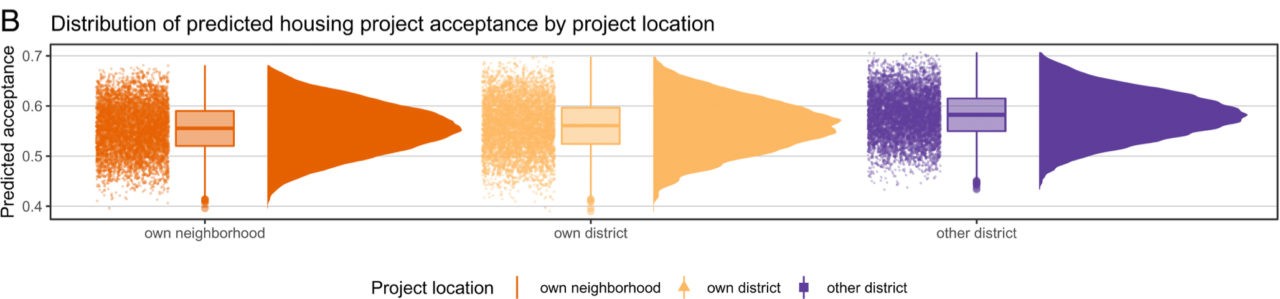
predicted acceptance levels for all possible projects (B) by Proximity frame. Error bars show 95% confidence intervals.

Michael Wicki, Katrin Hofer, David Kaufmann
2022
Full text

Dense and compact cities yield several benefits for both the population and the environment, including the containment of urban sprawl, reduced carbon emissions, and increased housing supply.

Densification of the built environment is thus a key contemporary urban planning paradigm worldwide. However, local residents often oppose urban densification, motivating a need to understand their underlying concerns. In order to do so, we examined different factors driving public acceptance of housing densification projects through a combination of a conjoint survey experiment and different proximity frames among 12,402 participants across Berlin, Chicago, London, Los Angeles, New York, and Paris. Respondents compared housing densification projects with varying attributes, including their geographic proximity, project-related factors, and accompanying planning instruments. The results indicate that the acceptance of such projects decreases with project proximity and that project-related factors, such as the type of investor, usage, and climate goals, impact densification project acceptance. More specifically, we see a negative effect on acceptance levels for projects with for-profit investors and a positive effect when the suggested developments are mixed use or climate neutral. In addition, planning instruments, such as rent control, inclusionary zoning, and participatory planning, appear to positively influence acceptance. Interestingly, a cross-continental comparison shows overall higher acceptance levels of densification by US respondents. These multifaceted results allow us to better understand what drives people’s acceptance of housing projects and how projects and planning processes can be designed to increase democratic acceptance of urban densification.

Proceedings of the National Academy of Sciences (PNAS), 119(38), e2201780119.
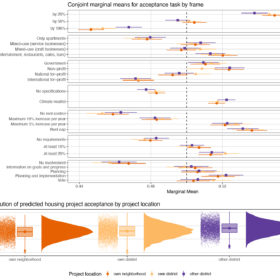
Figure 2, Planning instruments enhance the acceptance of urban densification, © ETH Zürich, IRL, SPUR

×
Share this...
  • Facebook
  • Linkedin
  • Whatsapp
  • Email
This article has been published in the following newsletter edition:

56 | Dezember 2022: Trans-disziplinarität

  • Difference in Urban Planning. Interdisciplinarity as an Approach to Understanding the Complexity of Contemporary Urban Societies
  • How can Urban Policy-makers Leverage Science and Technology to Create Safer, more Inclusive Cities that Serve the Needs of all Citizens?
  • Unlocking a Multidisciplinary Discourse on Architecture and the City
  • Critically Thinking and Acting on the Ground: An Interview with Christophe Girot
Kurzmeldungen
  • Entdecken, wie sich Landschaften anhören
  • Prof. Dr. Francesco Corman zum ausserordentlichen Professor für Transportsysteme befördert
Publikationen
  • Agadir. Building the Modern Afropolis
  • Re-considering the Status Quo: Improving Calibration of Land Use Change Models Through Validation of Transition Potential Predictions
  • Planning Instruments Enhance the Acceptance of Urban Densification
  • disP 58/2, June 2022
Aktuell
  • ETH Forum Wohnungsbau: 17. internationale Tagung «GENERATIONENWOHNEN – Von der Idee bis zur Umsetzung»
  • Bright environments: Daylight in Sustainable Building Design
  • Landmanagement – Weiterentwicklung eines Instrumentariums
  • Städtische Verdichtung und Verdrängung
  • Master of Science ETH in Landscape Architecture
  • MAS ETH in Housing

Chairs

Prof. Dr. Bryan T. Adey
Prof. Dr. Tom Avermaete
Prof. Maria Conen
Prof. Dr. Francesco Corman
Dr. Jennifer Duyne Barenstein
Prof. Teresa Galí-Izard
Prof. Dr. Adrienne Grêt-Regamey
Prof. Dr. Guillaume Habert
Prof. Dr. Eva Heinen
Prof. Damian Jerjen
Prof. Dr. David Kaufmann
Prof. Hubert Klumpner
Dr. Anastasios Kouvelas
Prof. Freek Persyn
Prof. Milica Topalovic
Prof. Martina Voser

Contact

Address
ETH Zürich
NSL – Netzwerk Stadt und Landschaft
Stefano-Franscini-Platz 5
HIL H 44.2
8093 Zürich

NSL Director
Director: Prof. Dr. Milica Topalović
Deputy Director: Prof. Dr. Eva Heinen

NSL Coordination
Claudia Gebert
Telephone: +41 (0)44 633 36 33


Register for the NSL Newsletter

disP Publication Office

Editor-in-Chief
Prof. Dr. David Kaufmann

Managing Editor
Dr. sc. techn. Martina Koll-Schretzenmayr, Spatial planner ETH/NDS,
Telephone +41 (0)44 633 29 47

Mailing address
ETH Zürich
Redaktion disP
NSL – Netzwerk Stadt und Landschaft
Stefano-Franscini-Platz 5
HIL H 33.3
8093 Zürich
Email disP editorial team


NSL Archive (gta)

Research and Bequest Archive for
Swiss Landscape Architecture and Spatial Planning

Contact

Consultation Requests


Privacy Policy